
Recruitment Matching AI
AI-driven matching of jobs and candidates — more efficient and more accurate than manual work
A solution that uses state-of-the-art AI to match the "intent of the job opening" and the "potential of the candidate" — dimensions that conventional keyword search could not capture. Tuned in-house to understand context specific to the recruitment domain. By calculating the "semantic proximity" of job descriptions and resumes in a high-dimensional dense vector space, we deliver high-precision matching that also captures qualitative requirements such as "customer orientation" and "culture fit" — requirements that are hard to articulate in words.
Challenges
Do you face these challenges?
- The Precision of Conventional Keyword-Based Matching Is Insufficient to Narrow Down the Optimal Candidate for a Role
Example: When a recruiter searches a job board or talent database with the keyword "Go," a large volume of unrelated results — such as those shown below — is returned.
- The Fundamental Limits of Keyword Search
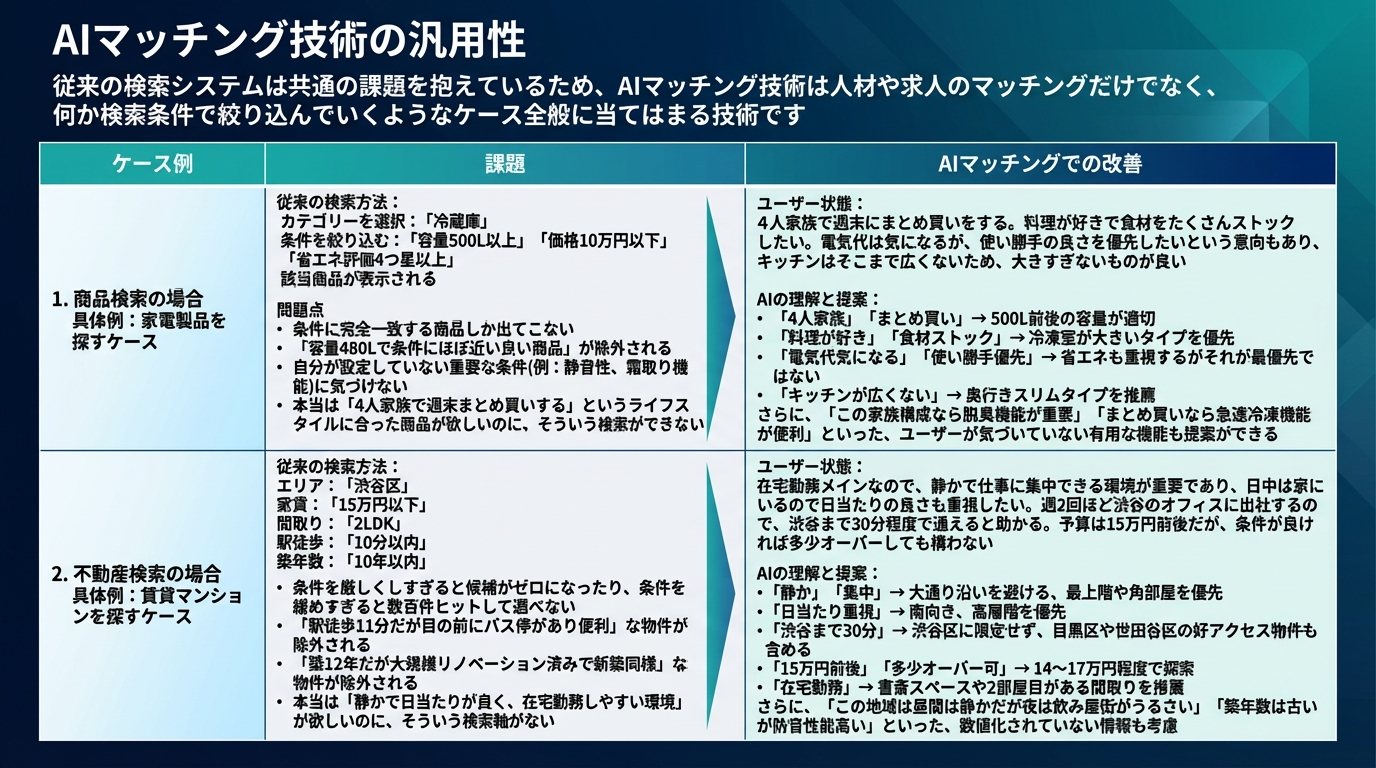
Keyword search judges only whether character strings match, so different expressions with the same meaning are shown as separate results. Furthermore, even when keywords match, it cannot judge the actual skill level.

The Fundamental Limits of Keyword Search
Keyword search judges only whether character strings match, so different expressions with the same meaning are shown as separate results. Furthermore, even when keywords match, it cannot judge the actual skill level.
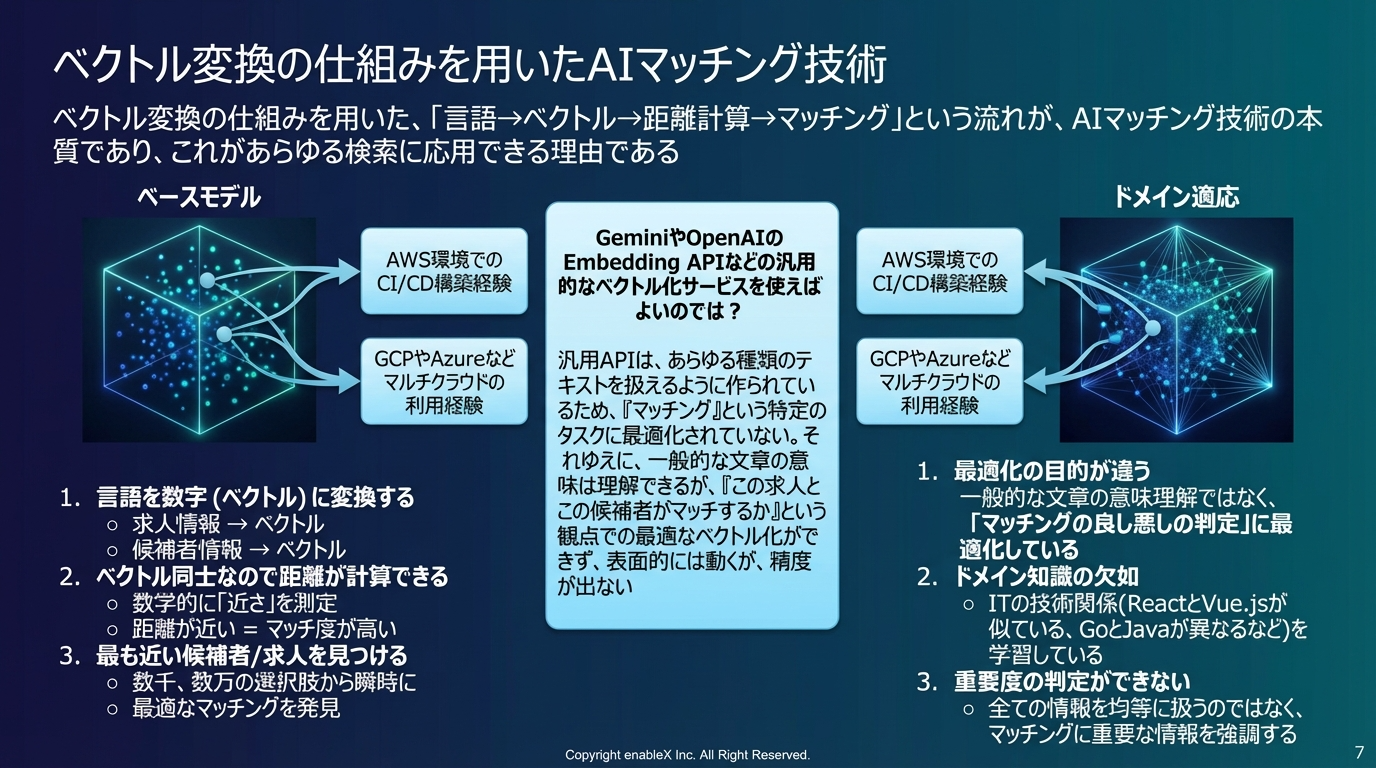
AI Matching Technology Built on Vector Conversion
The flow of "language → vector → distance calculation → matching" — built on vector conversion — is the essence of AI matching technology, and is the reason this technology can be applied to any kind of search.
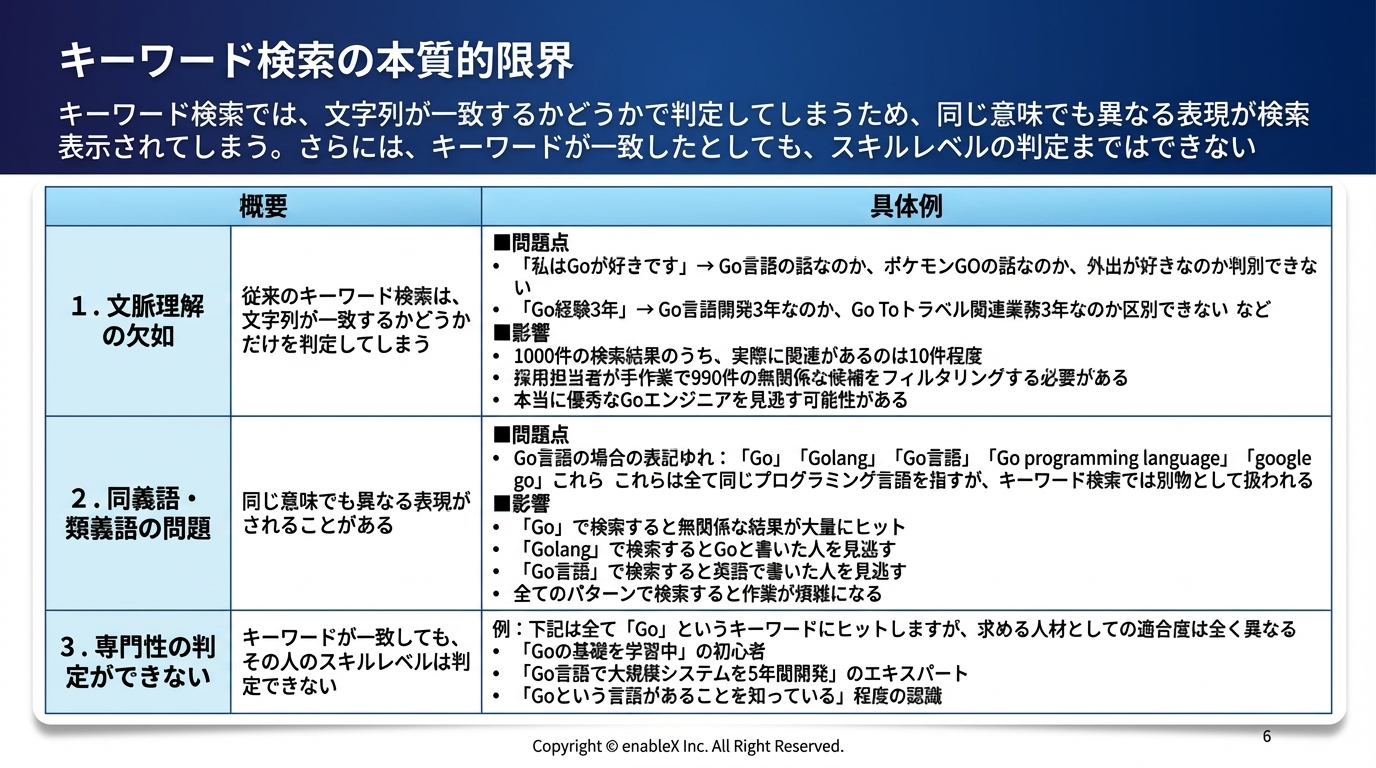
The General Applicability of AI Matching Technology
Because conventional search systems share common challenges, AI matching technology applies not only to talent-and-job matching but also broadly to any use case in which results need to be narrowed down by search conditions.

“After understanding the current data situation, development environment, and the structure driving the initiative, we propose the optimal solution.”
BizDev Executive Director - 執行役員
Our Professionals
Our expert team will support you.
Let's talk in detail
Our expert team will provide tailored proposals
Key Features

Meaning-Based Candidate Search
The AI automatically understands semantically close terms even when the wording differs — for example, "SRE" and "AWS Maintenance and Operations" — and extracts candidates who meet the requirements even when keywords do not match.

Matching Against Abstract Requirements
Qualitative requirements such as "customer orientation" — which are rarely written directly into resumes — are inferred by the AI from past behavioral history and descriptions of outcomes, and the AI then recommends matching candidates.

Reducing the Workload of Direct Sourcing
The AI replaces the candidate-listing work that recruiters previously performed using complex search queries. Simply by inputting a job description, the optimal candidates are instantly displayed in a ranked list, dramatically shortening the time to outreach.
Accuracy Improvement Through Optimized Training Data
Actual outreach-send history is used as training data. Furthermore, by performing domain adaptation specialized for the recruitment domain, we deliver higher accuracy than generic AI models.
Business Impact
Reduction in Matching Workload
New-Hire Attrition Rate


Why Choose Us
Implementation of State-of-the-Art Neural Information Retrieval
Rather than conventional sparse vector search, we employ Dense Retrieval based on dense vectors. By fine-tuning a BERT-based model with a Siamese network, we have built a production-grade search system that is both fast and highly accurate.
Deep Understanding of and Adaptation to the Recruitment Domain
Rather than a generic Japanese-language model, we perform additional training using actual job descriptions and resume data. This delivers an AI that accurately understands industry-specific terminology, named entities, and stylistic conventions in how descriptions are written.
Structuring Through Prompt Engineering
We have established a technique that gets the AI to recognize the unstructured data of job descriptions and resumes structurally, using special tokens such as [JOB_CATEGORY] and [SALARY]. This reduces noise in the data and further raises matching accuracy.
Our Professionals
Our expert team will support you.
Let's talk in detail
Our expert team will provide tailored proposals


Ready to transform your business?
Discover the value Recruitment Matching AI can deliver to your business.