Building an Asian Economic Sphere, Starting from Japan-Korea Cross-Border / Interview with Executive Officer Mr. Han
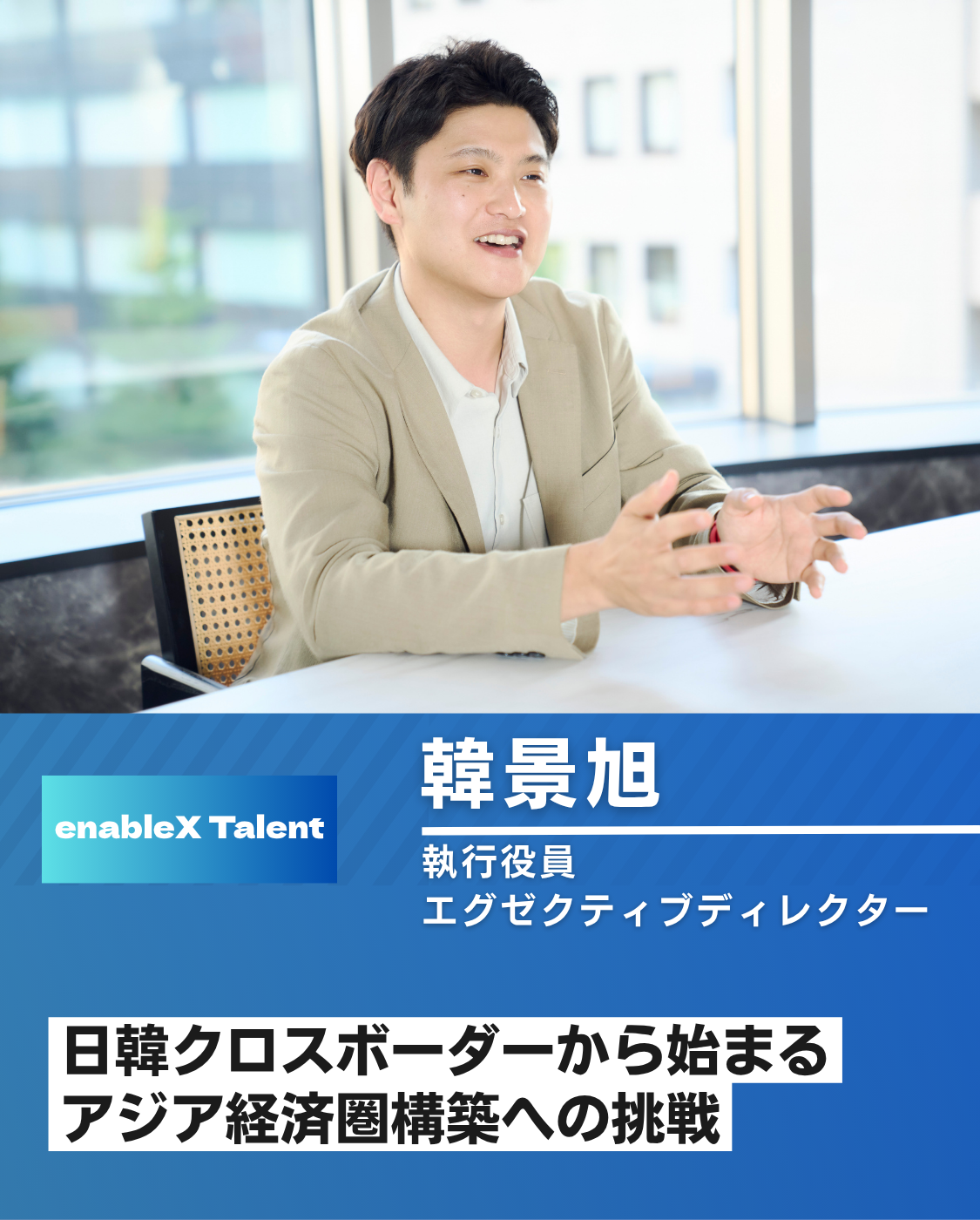
After Arthur D. Little, startups, and his own venture, Mr. Han became a leading practitioner of Japan-Korea cross-border business. Here, he discusses his decision to join enableX via M&A and his vision for building an Asian economic sphere.


Building an Asian Economic Sphere, Starting from Japan-Korea Cross-Border / Interview with Executive Officer Mr. Han
2025.07.31
From Arthur D. Little to a robotics startup, then supporting Korean startups' expansion into Japan, and founding his own Nofty Consulting — Mr. Han has been a leading practitioner of Japan-Korea cross-border business. Why did he decide to join enableX through M&A? We spoke with him about his grand vision of building an Asian economic sphere and the importance of "believing in yourself."
From Consulting to Startups, and Then a Bridge for Japan-Korea Business
— First, please tell us about your career to date.
Straight out of university, I joined Arthur D. Little (ADL), a foreign consulting firm, and worked there as a consultant for about two and a half years. I primarily handled new-business and overseas research projects for our clients.
What stands out the most is an IT platform business-strategy engagement for a major SIer. To inform their future platform strategy, we conducted an exhaustive review of overseas cases such as Uber and held interviews with overseas experts. That was around 2014-15 — exactly the "Software is eating the world*" era. AI today is what IT was back then. I became deeply interested in how large enterprises would incorporate the IT wave into their business strategies.
*The phrase "Software is eating the world" expresses the idea that every industry is being transformed and increasingly dominated by software.
I then moved to a Japanese robotics startup. There I led business development — handling hiring support, IP strategy, and more — but I wanted to build a business more substantially. After that, I joined the launch of a Korean SaaS startup in Japan. For about three years, I handled everything other than product development — from regulatory filings to back-office operations, sales, and partnerships. We had also received investment from a major operator, so I drove open-innovation collaborations as well.
That startup ran several businesses, but when it closed operations due to COVID, I left and founded Nofty Consulting.
— Could you tell us more about how you started your own company?
The Korean startup I just mentioned had been quite successful over those three years, and I started receiving more and more inquiries from other Korean startups saying, "We're interested in doing business in Japan, but no one else is doing it well." Many requests came in for introductions to people, and I concluded that supporting multiple companies — not just one — would create greater impact in the world.
Also, while there's a lot of expansion from Korea into Japan, I believe it's equally important to expand from Japan into Korea. Japanese companies are increasingly collaborating with Korean startups, but they need to step into Korea more actively, partner with local companies that hold strong technology, and scale them up in Japan.
In technology in particular, Korea is highly advanced. There are many people returning home from the U.S., and my impression is that there are more products competing at a global level than in Japan. Japan's IT startups need to bring those products into Japan, compete globally, and raise their own level.

M&A for Personal Growth — and the Potential of Enterprise × Cross-Border
— Why did you consider M&A as an option?
Honestly, M&A wasn't on my radar at first. The company was profitable, and in the short term we could have continued operating without issue.
I chose M&A for my own growth. Nofty Consulting wasn't large in scale, and I was wrestling with how to take the next step. Around that time, Mr. Kemmochi, the CEO of enableX, reached out to me.
Through conversations with Mr. Kemmochi, I came to think, "If I can elevate my perspective as a leader and scale the company, the impact I have on society will grow accordingly." I chose M&A as a means to step outside my comfort zone.
**—enableX — how do you think about the synergies?**
Nofty Consulting's work was largely with startups. As a result, I felt we needed to take more of an enterprise perspective and pursue cross-border work at that level.
enableX has a rich track record with enterprise clients. If we can absorb enableX's enterprise strengths and combine them with our network of Korean startups and Korean enterprises, I believe we can grow dramatically.
Particularly for the Japan-to-Korea direction, outside of IP content, there's still substantial opportunity in IT software. If we can bring those conversations to enterprises, I believe we can generate even greater impact on society.
— How do you see the current state of Japanese companies' expansion into Korea?
It varies by company. Some, like Toyota Tsusho — which invested in a Korean secondary-battery company this year — are moving actively, but many companies remain in wait-and-see mode.
By sector, content and IP companies are very active in pursuing Korean-wave content. Animation studios facing labor shortages, in particular, are showing aggressive moves — such as setting up JVs with Korean studios. On the other hand, many IT software companies still think, "Korea — we don't really get it," or "Wouldn't the U.S. be a better bet?"
But when you consider business customs, the language barrier, time differences, and geographic distance, Korea is actually a lower hurdle than the U.S. I travel to Korea almost every week — it's that easy to go back and forth. The software domain has plenty of room for more activity.
The Grand Vision: Building an Asian Economic Sphere, Starting from Japan-Korea
**—enableX — could you share the vision you're drawing for the future?**
We're focused on Japan-Korea now, but I want to broaden that further.
I often discuss this with Korean companies — globally, with China and the U.S. as two poles, the key question is what countries like Japan and Korea, which have meaningful economic scale but sit between those two, will do going forward.
Germany is often cited as an example: it's said that an economy of roughly 80 million people can sustain its own economic sphere. With populations declining in both Japan and Korea, the two need to draw closer together to maintain economic scale and continue growing.
This shouldn't be confined to Japan-Korea — from the perspective of an Asian economic sphere, we should join hands with Taiwan, Singapore, and Southeast Asia to expand. By providing behind-the-scenes support to Japanese companies' expansion into the Asian economic sphere — as enableX, which understands both local markets and Japanese business — I want, ultimately, to drive moves that widen the economic sphere to include the U.S., China, and Europe.
Don't Hesitate — Take Action, with People Who Believe in Themselves
— Mr. Han, what kind of person would you like to work with at enableX?
I'd like people who want to bring in products from abroad — for now still limited to Korea — that are competing at the global level, bring them to Japan, and raise Japan's level together with us.
A minimum of language ability is required, but what matters more is being able to draw in and engage outside people — and to do so without the bias of "it's been done this way before, so it can't be done."
As a real example, there's someone on a client team expanding into Korea for the first time who can't speak Korean at all — but they fire off messages on LinkedIn, recruit people, and win customers. People like that, who don't hesitate to take the initiative, are an exceptional fit.
This may sound contradictory for overseas expansion, but the biggest risk is being so caught up in the idea that "because we're abroad, we have to do it this way" that you can't move. I'd rather have someone willing to make mistakes and just put out lots of attempts. Rather than getting locked into fixed notions just because it's overseas, I want people with the courage to say, "Let's just give it a try!" and throw everything they can at the problem.
**— Finally, enableX — please share a message for those considering us.**
I want to work with people who can believe in themselves.
To put it more concretely — not in an arrogant sense, but rather, someone who, when faced with something they've never done, can think, "I think I can pull this off," with optimism and self-belief. The smarter someone is, the greater their fear of the unfamiliar — and that fear becomes the biggest obstacle.
The smarter you are, the more I want you to find the courage to dive into what you've never done before. Business development, I believe, has exactly that quality.
"I've never done AI," "my language skills aren't strong," "I've only ever consulted," "I've only ever worked in operating companies" — many people feel fear around things like these. But believe in yourself and dive in.
At enableX, let's take on the grand vision of building an Asian economic sphere, starting from Japan-Korea cross-border, together.