Toward New Value Creation with the Twin Engines of AI-Native "Consulting × Business Development" — Interview with Executive Officer Zhou
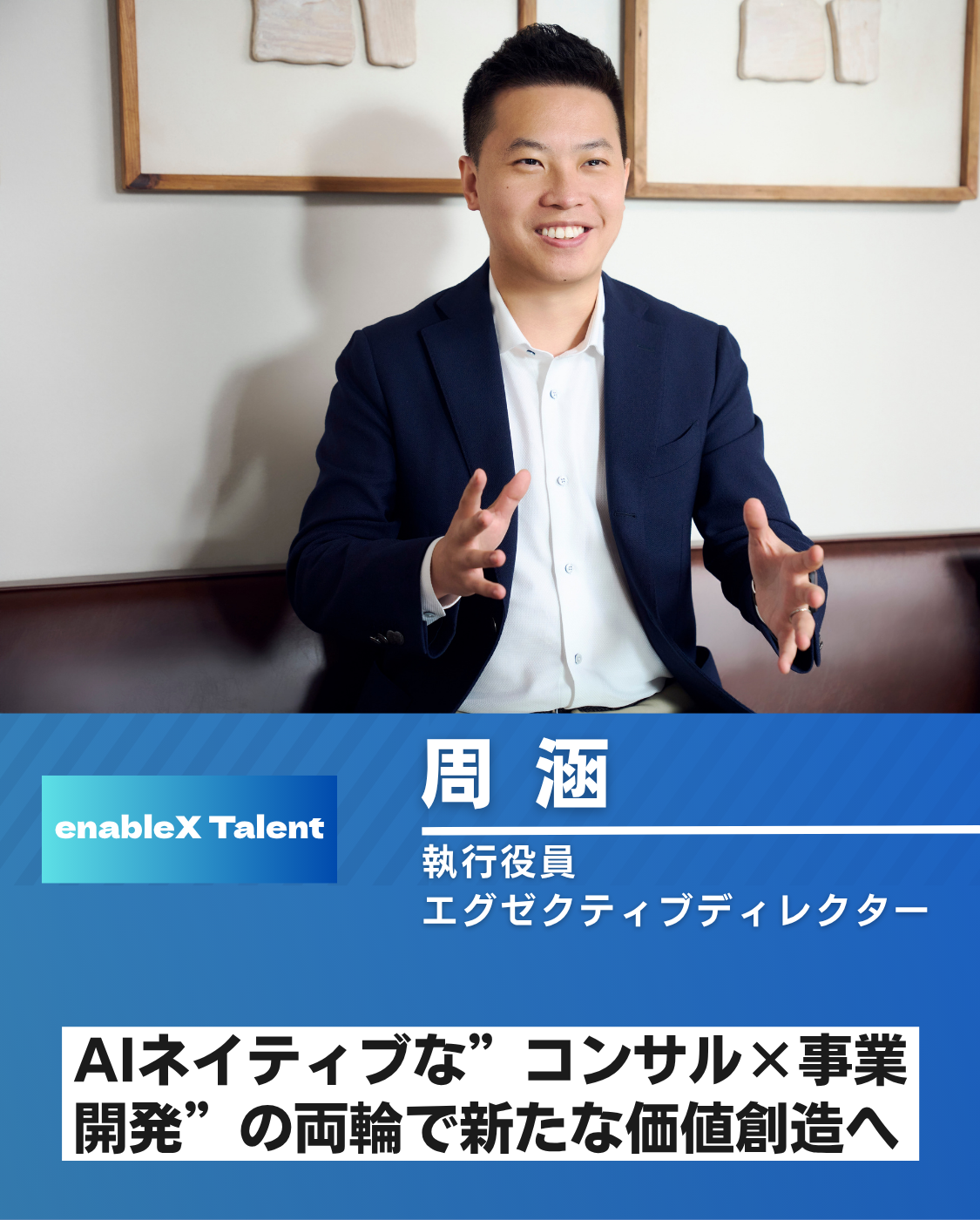
After consulting at McKinsey, business development at an AI startup, and running his own company, Executive Officer Zhou joined enableX. He speaks about his vision of creating new value with the twin engines of AI-native consulting and business development.


Toward New Value Creation with the Twin Engines of AI-Native "Consulting × Business Development" — Interview with Executive Officer Zhou
2025.07.31
Zhou serves as Executive Officer at enableX. After his consulting experience at McKinsey, his business development experience at an AI startup, and running his own company, what led him to join enableX? We asked him about his vision for an AI-native consulting firm × business development.

From McKinsey to an AI startup — a career anchored in the application of technology
— First, please tell us about your career to date.
I joined McKinsey & Company as a new graduate and spent exactly four years there. I primarily covered the technology sector, working across a wide range of engagements for manufacturing and high-tech companies — from strategy formulation to operations reform to technology implementation.
The turning point came in 2018-2019. It was right when machine learning and AI began drawing rapid attention, and many Japanese companies started exploring AI proofs of concept (PoC) and embedding AI into their business strategy. During this period, I was driving AI deployment projects for a variety of companies as part of the AI team.
However, as we worked through these projects, I saw many engagements that did not progress to actual implementation. On the client side too, things often ended at the PoC stage and never connected to real business development. Watching this play out, I frequently had conversations with the project leader at the time: "Wouldn't it be faster if we built the business ourselves?"
And when that senior colleague said, "All right — I'll start my own company," I jumped in to help launch Neural Pocket (now Neural Group), an image-analysis AI company.
— What was your role at Neural Pocket?
As COO (Chief Operating Officer), I oversaw the entire business side — sales, business development, marketing, and alliances. Starting from zero, I built everything, including hiring the team.
Concretely, we developed and sold B2B solutions powered by image AI. We provided projects — such as counting cars and people via AI cameras, and facial recognition — to real estate developers, transportation operators, and railway companies.
Across nearly five years, I also went through the company's IPO. In the acquisition and subsidiarization of a related device company, I served as that company's president. I gained experience not only in business development but also as a senior executive.
We aggressively expanded overseas — dealing with companies in Southeast Asia and China, selling AI cameras in Thailand, and pursuing many cross-border projects — which proved an invaluable experience in deploying an AI business from a global perspective.
— And then you went independent.
Yes, after that I established a company called Aspiretech Consulting. While running custom development of AI solutions and a consulting business, I drove a variety of AI-powered projects. As a result, for over eight years I have consistently focused on the theme of how AI changes operations and businesses.
Feeling the ceiling of scale, and looking for a partner for essential value creation
— Why did you consider M&A as an option?
Aspiretech Consulting was run with a minimal team of just a few people. We were growing reasonably well, but about a year ago I began to feel a ceiling — "if we operate with this setup, we have hit our limit."
What I felt most acutely was the lack of functions. As you try to drive business development in earnest, you need diverse expertise — marketing, finance, and in some cases the execution of M&A. We had a reasonable supply of engineers on the AI side, but we had no marketing members, and we could not take on finance-related engagements.
We were also receiving inquiries we had to turn down, and considering the team structure, I strongly felt we needed to join forces with someone. In that context, M&A was a leading option.
— Among the many options, why did you choose enableX?
The biggest reason is that enableX is pursuing a new form of consulting.
Speaking from the standpoint of having moved from consulting to an operating company, the traditional consulting that "creates a lot of slides, presents the proposal, and is done" is losing its raison d'être year by year. Clients now expect partners who accompany them until real outcomes are delivered — going beyond mere suggestions to present actual solutions and, in some cases, to build a business together. That is what is being asked of us.
However, talent that can actually do this is in fact very scarce. People with both consulting experience and operating-company experience are rare. From my own experience, in business development the mindset of "I am the protagonist" tends to grow strong. That is itself a necessary element for business growth, but in consulting you must put the client front and center and dedicate yourself to the role of the unseen supporter.
People who understand this balance and can play the right role at the right time are unexpectedly rare. Without your own experience running a business and a real sense of "I made this happen," you can't always make the choice to stay in the supporting role. On the other hand, without operating experience, you can't accompany clients in a way that isn't purely theoretical.
At enableX, members who possess both of these qualities are coming together. This is the reason I felt that, with enableX, we could realize truly meaningful consulting.
And of course, the fact that functions we had been missing — such as marketing and finance — would expand all at once was also a major appeal. We can now take on engagements we previously had to turn down, and provide more comprehensive value.
An AI-native consulting firm and a business development studio — two ambitious visions
**— Going forward, what kind of business do you want to develop at enableX?**
I have two broad visions.
1. Realizing the management of an AI-native consulting firm
First, the development of generative AI over the past two to three years has dramatically changed the shape of the consulting industry. Work that once held value — "gathering and organizing information" — is now done at a higher level by AI. At worst, situations are emerging where AI's level exceeds that of the consultant.
In that environment, what should consultants be doing? What traditionally large firms such as McKinsey or Accenture cannot do is precisely what an emerging firm can. That is where I see the opportunity to win.
Traditional consulting is an extremely individual-dependent business. McKinsey, BCG, Accenture — each has its own firm character, but if the people inside move out, the destination effectively becomes a new McKinsey. When a key person leaves, revenue suddenly drops. That kind of fragility is built into the model.
What we aim for is building highly reproducible operations using AI. From sales, through actual engagement delivery, to knowledge sharing — we will fully leverage AI to achieve maximum efficiency with the smallest team.
Concretely, we will create a state in which a consistent level of quality is always delivered regardless of who handles the client. Internal research and information gathering are done by the shortest path using AI, and our time is freed up for the truly important work — management decision-making, discussions on new business development, and providing essential hands-on support.
2. Building a reproducible business development studio
The second vision is to build a "playbook" for business development — particularly new business development.
Actually, new business development has no established playbook. MBAs offer textbooks on management, but new business development is summed up with the word "entrepreneurship," and a concrete methodology has yet to take shape. Recently there are also classes at Silicon Valley universities, but the content often resembles brainstorming sessions and is not necessarily practical.
Moreover, conditions differ significantly by country. Things said in Silicon Valley do not work when applied directly to Japan. We need to systematize a process for creating new businesses in the regions we cover — Japan and Asia.
Of course, in the end there remains an artistic element — the inspiration of the leader. Yet beyond that, we want to build the minimum playbook — "these are absolutely the things you must do" — and launch new businesses with reproducibility. We want to bring our client companies to a state where they can keep producing new businesses one after another.
A "business development studio" structure of this kind is, I believe, something no company today has truly realized. If we can build it, it would be an extremely powerful form of value provision.
A system that closes experience gaps — so that everyone can bring the twin engines to bear
— Can people with only consulting or only operating-company experience also thrive?
As you say, people with both forms of experience are very scarce. It would defeat the purpose if enableX could not pursue what it wants to do unless we could hire only such people.
Therefore, by leveraging the systematic processes and the playbook that enableX is building, I want to create an environment where things that would normally take two to three years of apprenticeship at an operating company can be picked up in roughly a three-month project.
For those with only consulting experience, the practical aspects of business development. For those with only operating-company experience, the consulting mindset and how to accompany clients. To build mechanisms by which each can be acquired by the shortest path, what matters most is learning through practice.
After keeping the catch-up period as short as possible, members accumulate experience through projects and become able to drive the work with both perspectives. As an operation across the whole company, I want to build a system that supports that kind of growth.
— Finally, what kind of people would you like to work with? A message, please.
The greatest appeal of enableX is that talent interested in both consulting and business creation is gathering here. I would love to work with people who want to drive advisory work and business creation as twin engines.
It is fine if your experience to date has been weighted to one side. What matters is the willingness to take on both.
What we aim for is not traditional consulting that simply produces and hands over reports, but a commitment to creating essential value for clients — particularly the new businesses that become new revenue streams. We are looking for people who want to be fully immersed in that kind of work.
We will take on never-before-seen value creation with the twin engines of a new form — the AI-native consulting firm — and the concept of a business development studio. Let us build the new standard for the consulting industry together.