Spacemarket's Growth Strategy — Evolution and New Challenges Through M&A and New Business Creation
This article explores the background of the Spacemall M&A and the post-merger integration (PMI) strategy, along with Spacemarket's new business creation process, its approach to talent development, and the corporate culture that drives new ventures to success — delivering the growth story Spacemarket is charting for the future.


Spacemarket Inc., President and CEO, Mr. Daisuke Shigematsu
Under the vision of "creating challenges and making the world more interesting," Spacemarket operates a marketplace where vacant spaces can be rented out by the hour, and since its founding in 2014 has continued to grow as a pioneer in the market.
To accelerate growth in the space-sharing market, the company is expanding its business on two wheels — M&A and new business creation. Through the 2021 M&A of Spacemall, it raised the quality and speed of operations and made further business expansion and growth possible.
In addition, new ventures such as "Spacepad," born out of the internal new-business idea competition, were launched starting from employees' own passion and problem awareness, and are growing by leveraging both internal and external resources.
This article explores the background of the Spacemall M&A and the post-merger integration (PMI) strategy, along with the new business creation process, the approach to talent development, and the corporate culture that drives new ventures to success — delivering the growth story Spacemarket is charting for the future.

Spacemarket Inc., President and CEO, Mr. Daisuke Shigematsu
Background of the Spacemall M&A
—— Thank you for taking the time today. Spacemarket has been running a space-sharing platform in Japan, and the 2021 M&A of Spacemall — which provides design, planning, and operational outsourcing services for rental spaces — is still fresh in our memory.
We have been very much looking forward to this conversation.
Thank you, and likewise.
—— To begin with, how does Spacemarket draw the line between businesses launched internally and those launched through external M&A?
The businesses Spacemarket pursues in-house are mainly expanded into areas where we can leverage the know-how, knowledge, and strengths we have accumulated.
Conversely, we have been considering M&A as a way to combine existing know-how and knowledge to generate new synergies.
—— So would you say the business domain of Spacemall, the company you acquired, was an area in which Spacemarket had relatively little know-how?
Spacemall, which provides operational outsourcing for shared spaces, did hold know-how in the sense that it creates the "space-usage experience."
—— On the other hand, in terms of operating shared spaces themselves, the knowledge and know-how that Spacemall has built was an area where we had only limited expertise.
—— —— I see. So you did not have the knowledge or know-how for shared-space operations itself, and that is why you considered M&A.
When operating shared spaces, what are the truly important parts of the work?
In running shared spaces, the most important task is "cleaning."
Hiring and scheduling the cleaning staff, and building a system in which guests also do part of the cleaning — that part is genuinely difficult.
Also, competition in the rental space market is intensifying in a healthy way, so raising cleaning quality and keeping rented spaces consistently clean becomes a strong competitive advantage relative to rivals.
We understood intellectually, from customer feedback and reviews, that keeping spaces clean is important. But by actually working alongside Spacemall, we came to truly appreciate how important cleaning is and how demanding it is to operate that workflow.
—— So in space operations, "cleaning" turns out to be a crucial part of the business.
Could you tell us the background of how you came to pursue the M&A of Spacemall — which was also a host (user) on your own platform while you were running your space-sharing business in-house?
Originally, Spacemall was a host company that listed its spaces on Spacemarket.
Precisely because we were running a space-sharing business ourselves, we judged that acquiring Spacemall — and combining Spacemarket's management assets with Spacemall's operational know-how — would enable continued growth, and that is what led to the M&A.
Why Spacemall specifically? Their customer service was strong, and the direction of the business their leadership envisioned, along with their way of thinking, aligned well with Spacemarket's management team.
Spacemall was also expanding rental spaces at a fast pace, and we believed that by bringing that know-how into Spacemarket, we could create synergy and grow the business even further.
Because the space-sharing market is one in which quality must be maintained while rapidly scaling, we view M&A as a powerful means of raising corporate value and want to expand the business with greater speed.
—— There must have been many candidate companies for M&A — how did you go about evaluating which companies, including Spacemall, to acquire?
We focused our M&A consideration on companies that were already transacting within the Spacemarket platform.
Even before seriously considering M&A, we maintained regular communication with our partner companies as part of routine business, so it was not the case that we suddenly raised the topic of an M&A out of the blue with the leadership of a partner company.
The moment we broached M&A with Spacemall was simply a natural extension of that regular communication — we said, "Why don't we deepen the business together?"
—— The way founders approach companies varies — one acquaintance of mine, who is somewhat eccentric, even uses the line "I want to mix blood" when pitching M&A.
As you progressed with the M&A discussions with Spacemall, what were the main points of debate?
Looking back at that time, there were surprisingly few major points of contention up to the M&A.
Spacemall's founder (Mr. Koizumi) had been considering a sale as one option for the company's direction, so when we brought up the M&A he was not particularly surprised, and we were able to move forward constructively.
To generate more synergy going forward, we considered the equity structure important, and as a signal of our intent to operate together as a group company, we also distributed stock options.
Lock-ups generally have more of a "gentlemen's agreement" character, but Spacemall's representative, Mr. Koizumi, is still working hard on the business today — even now that his lock-up has already expired.
Entrepreneurs come in many types, and the fact that even before the M&A — and even after the lock-up would expire — Mr. Koizumi said he would remain committed to the business was one of the deciding factors for us in selecting the M&A target.
One of the lessons I have taken from this M&A is that meeting many companies' leaders has reaffirmed for me just how differently each leader thinks about their company and their business.
—— So the points of negotiation were limited. Then how did you carry out Spacemall's valuation and the due diligence (DD) on cleaning — the key element of the space-sharing business?
Regarding DD — because Spacemarket was running the same space-sharing business as Spacemall, we already had a feel for the key points, which was a major advantage. I think there are many things you cannot understand or easily overlook unless you have actually operated the business yourself.
Also, cleaning quality and similar metrics had already been captured as data on the Spacemarket platform, and we ran the DD while also referencing concrete customer comments.
—— So the fact that Spacemarket was running the same space-sharing business proved valuable for both the valuation and the DD.
Exactly — doing the same business in-house was extremely useful.
Both while we were considering the M&A and now that Spacemall is part of the group and we are running the business together, I feel that actually getting our own hands dirty is essential to understanding the key indicators and elements of the business.
—— Even from the platform side, we understood how demanding holiday complaint handling and the operations around cleaning can be.
Precisely because we were running the business ourselves, we could understand at a high resolution the quality of Spacemall's operations relative to other companies, and I believe we were able to evaluate the company accurately.

Post-M&A PMI and business synergies
—— One of the difficult aspects of M&A is the PMI afterwards. From the perspective of organizational structure and systems, to what extent have you integrated Spacemarket and Spacemall?
We have intentionally kept a certain distance between Spacemarket and Spacemall even after the M&A — offices, salary systems, and corporate missions are deliberately kept separate.
While ensuring security, communication between the two companies' employees is free, but the company does not actively set up formal venues for them to communicate.
Since office space is also rented out on weekends and weekday evenings, employees do communicate to some extent, but the only official cross-company exchange event has been roughly the 10th anniversary celebration.
—— Were there any differences in inter-company operations or platform transactions before and after the Spacemall M&A?
There was not really any major change in the operational transactions between the two companies before and after the Spacemall M&A.
As Spacemarket runs a platform business, conflicts with customer companies that compete with Spacemall are something people often worry about.
However, as a platform operator, we maintain free competition — including with Spacemall's competitors.
We are aiming to grow the platform further, and we believe that favoring Spacemall would, over the mid-to-long term, cause the platform itself to stop functioning.
On the other hand, as we expand the space-sharing business through Spacemall, the potential for cannibalization with the platform business is rising, and honestly we work through it day by day with trial and error.
—— Cannibalization is a tough issue. Conversely, you also receive investment from companies — were there any changes in the business before and after taking on those investments?
Spacemarket has received investment from several major companies, and after they invested, the frequency of our conversations increased and their involvement in the business grew as well.
At the same time, transactions with other competing companies that have not invested in Spacemarket have not become harder, and we have felt almost no downside to receiving investment.
On the other hand, I do hear that when the investor side is a large enterprise, internal approval workflows can become harder for transactions with companies they have not invested in — holding equity can change how things move internally.
—— From the business perspective, what kinds of changes and synergies have you seen before and after the M&A?
For Spacemarket's platform business, the Spacemall M&A has raised our resolution of host understanding and the challenges they face, improving the quality of the platform and making business expansion easier.
Spacepad*※1* is also a business that could only be launched because, by acquiring Spacemall, we discovered the operational challenges that needed solving.
※ Spacepad: A cloud-based reservation and management system that digitalizes booking and management of all kinds of facilities and simplifies cumbersome facility management work.
Also, Spacemall's service had many analog elements, and by leveraging Spacemarket's development expertise, productivity has improved as well.
On the financial side, separate from the business itself, being a group company of a listed company has also made it easier for Spacemall to take on debt.
Going forward, we want Spacemall and Spacemarket to keep leveraging each other's resources and expand the business further.
—— Creditworthiness is indeed important when expanding a business. Also, Spacemarket has been increasing cooperation with local governments and major enterprises — is that connected to the Spacemall M&A?
Through the Spacemall M&A, our touchpoints with local governments and large enterprises have grown.
Starting from the space operations business, the range of proposals we can bring to corporate clients has expanded and the process runs more smoothly.
In fact, as we visit regional areas and exchanges with local governments grow, I have come to feel firsthand how many parts remain analog — rental-space key management, gymnasium and pool reservations on paper — and especially from regional local governments we receive many inquiries about Digital Transformation (DX).
Reservation systems are also being introduced for things like local governments' child-rearing consultation appointments — demand for reservations beyond just physical space is broadening.
—— Local governments still have many analog elements. How is your work with large enterprises going?
Looking at the broader market trend, growth in demand for small individual party spaces has slowed somewhat.
On the other hand, use as corporate workspace is growing — combined uses such as training plus a social hour for 20–30 people in mid-to-large spaces are also increasing.
As for collaborations with large enterprises, we have planned tie-ups with major beverage manufacturers — for example, collaboration events using their beverages combined with Spacemall's spaces — and we are also raising brand awareness through such partnerships.
For consumer goods makers and beverage makers, there is a clear benefit to leveraging rental spaces to broaden touchpoints with potential customers, so tie-up campaigns between rental spaces and brand companies are increasing.
—— So collaborations with large enterprises are growing! As you have pursued B2B sales, what have you learned?
Tangibly, I have come to understand that large enterprises watch their competitors' moves closely, yet remain cautious about new initiatives until reference cases emerge.
One example: a company running a karaoke business saw that business stagnate after COVID-19.
There, Spacemarket proposed ways for them to put their space to better use, and they actually took it on.
Then, as other companies in similar "box" businesses began asking us to tell them about the space business, and as more of them accepted our proposals, the number of companies moving to make better use of their spaces has grown.
—— How did you stand up the B2B sales organization?
At first, we made proposals using existing staff who had no B2B sales experience, but it did not go well. By newly hiring experienced people and reconfiguring the organization, we were able to get it on track.
—— Mr. Okada of Progrit said the same thing about B2B sales organizations — when Progrit first launched its new business, they tried with existing staff and could not get it off the ground, but as soon as they hired experienced people, it took off.

Spacemarket's new business creation process
—— At Spacemarket, new businesses are being launched — how are the seeds of those new businesses generated?
At Spacemarket, we have held an internal idea competition for new business in the past. Spacepad — one of our core businesses — is in fact an idea pitched at that competition by Mr. Takao, who today serves as Spacepad's head.
The origin of the Spacepad business was a consultation we received from Yuzawa City in Akita Prefecture about how to make better use of its spaces.
By the time the idea was proposed at the idea competition, we already had a clear understanding of customer needs and high confidence in horizontal expansion, and that led to launching the business.
Rather than direct one-on-one pitches between the proposer and the executives, the meaning of doing it as an idea competition is that judgments on new business ideas are made, and consensus is built, in front of not only the executives but all employees.
All employees see the story of the new business, gain understanding of it, and the proposer also gains a success experience.
—— Employees' understanding and support is important when pushing a new business forward. What kinds of struggles did you face before the new business got on track?
New businesses take time to show results, and from the perspective of people in existing businesses it is hard to tell what they are doing — so isolation is one of the challenges.
We do not have this issue at Spacemarket, but a common bad pattern is executives pressing the new business on investment and return in pure numbers.
Every kind of business is extraordinarily difficult to get off the ground, and internal understanding is essential.
That is why we believe it is critical for executives and the new business members to hold regular 1-on-1s and for executives to send internal messages so the whole company understands that "new business is necessary for the company" and "just how hard it is to launch one."
—— So the executives are leading the support for new business. What were the factors that gave you the conviction to invest more in Spacepad and scale it?
When Mr. Takao, the proposer, actually went around community centers and gymnasiums in Yuzawa City, Akita, and listened on the ground while also helping build the official website, elderly residents themselves began to be able to use the digital service.
Use of paper reservation ledgers steadily declined, and when we heard expressions of gratitude directly from staff and citizens, the new business team's motivation rose. We thought, "If we can do it in Yuzawa, Akita, we can do it in other regions," and made the decision to invest more and scale.

Characteristics of people suited to new business
—— When Spacemarket launched the hourly-rental platform business before the Spacemall M&A, who was in charge of new business?
Mr. Takao — who, as mentioned in the idea-competition story, leads Spacepad — was involved in the hourly-rental platform business from the very beginning.
Mr. Takao was also there in Spacemarket's early days, and he is genuinely good at — and loves — launching businesses.
His experience launching the space-sharing business has also been put to use in the launch of Spacepad.
—— As a company leader, do you also see new business as a means of developing talent?
Yes — we think of new business as talent development as well.
Through new business, people can notice critical processes and perspectives they had been missing — and many skills and abilities can only be acquired by actually running a business.
—— There are indeed capabilities that only come from new business. What characteristics do you think are suited to launching a new business?
I believe new business cannot be launched without people who have strong passion and can be "crazy" about it in the best sense.
Even if you bring in talented people from outside, without strong passion and problem awareness they cannot win the understanding of those inside the company and drive the new business forward.
Also, new businesses in new domains are full of unknowns, and you have to study and update constantly along the way.
So the ability to take on areas you have no prior experience in with curiosity is another essential element for driving new business.
—— It is indeed important to place people with passion and curiosity in new business.
In fact, when we launched Spacepad and pushed proposals into local governments to expand it, no one inside had local-government sales experience or knowledge of services for them. The first six months to a year were especially hard, and the business was not generating clean revenue.
But led by Mr. Takao, through listening sessions with local-government staff, we updated our knowledge and built a product tailored to local governments. Users grew, and we began receiving budget allocations.
Having strong passion and tackling areas you lack experience in with curiosity are characteristics of people suited to being early-stage members of a startup — and I have come to feel this again through launching various new businesses.
As management, we focus on providing "high-quality business ideas and a workplace environment" so that the curiosity of those people can be sparked.
—— From an individual career perspective, what do you see as the merits of launching a new business by leveraging the company's resources?
This may sound conventional, but the company has accumulated know-how, customer relationships, and people skilled across many fields — and by tapping those resources, you can stand up a 0-to-1 venture faster than starting your own company. That is the merit of launching a new business within a company.
—— What kinds of abilities and experiences are gained from launching a new business?
Launching a new business requires bringing along internal talent — executives and members — and sometimes external people as well to drive the business forward, and you gain capabilities for driving a business that you cannot acquire in existing businesses.
It is hard to put into words, but unless you actually run a new business there are critical tasks and perspectives you will miss, and many skills and abilities cannot be acquired through routine work.
Also, for those considering founding their own company or moving to a startup as a career step, launching a new business resembles startup work and is a good experience.
In my own career, I joined NTT East right out of university, then worked at Photocreate, and then started my own company.
Compared with NTT East, the skills and abilities I gained working at Photocreate — where the business environment was less established — have been enormously useful in founding and growing Spacemarket.
—— You mentioned that new business requires people with passion and problem awareness — how do you hire them?
Hiring people with passion and problem awareness is genuinely difficult.
Such people are rare and not easy to meet.
Even when you do meet them, it is rare to bring them on board immediately.
So when you do meet someone with strong passion, I think it is important to keep communicating with them over the mid-to-long term.
—— I see. So how was Mr. Takao — who launched Spacepad — actually hired?
I met Mr. Takao in his fourth year of university.
Mr. Takao had been running a business related to free-paper advertising since his student days, and he joined Recruit after graduating.
I stayed in regular contact with him through his student days and during his time at Recruit, and when he was considering going independent, Mr. Takao reached out to me.
—— Mr. Takahara of TWOSTONE&Sons said the same about hiring — that you cannot really hire people with passion through recruiting channels, and that when you meet good people it is important to keep reaching out with messages like, "Why don't we work together?"
—— Thank you for an interview full of insights — on the background of the Spacemall M&A, on creating new businesses, and more. We will continue to root for Spacemarket's further growth!
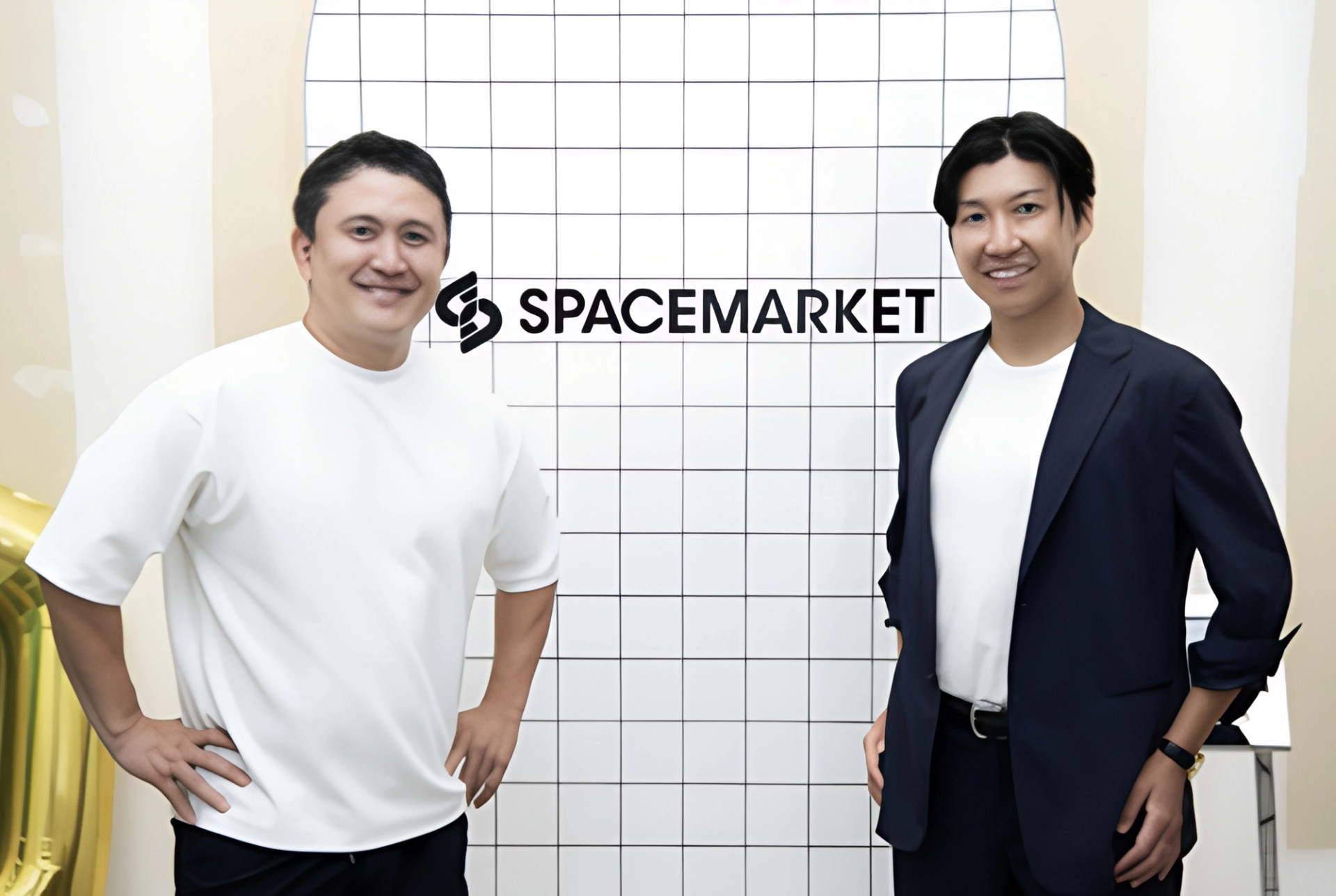
(Left) Mr. Daisuke Shigematsu of Spacemarket, (Right) Mr. Yoji Nakamura of enableX
About Spacemarket
Under the vision of "creating challenges and making the world more interesting," Spacemarket is a company dedicated to building and expanding the culture of space-sharing. The company was listed on the Tokyo Stock Exchange Mothers (now the Growth Market) in 2019. Its marketplace for renting out spaces, "Spacemarket," lists more than 37,000 spaces across Japan.
It also provides "Spacepad," a cloud-based public facility reservation management system that digitalizes the reservation management of all kinds of facilities and simplifies cumbersome facility management work.
Company name: Spacemarket Inc.
Address: JRE Jingumae Media Square Building 2F, 6-25-14 Jingumae, Shibuya-ku, Tokyo
Representative: Daisuke Shigematsu, President and CEO
Securities code: 4487
Founded: January 2014
Business: Operation of the space-sharing marketplace "Spacemarket," and provision of the cloud-based public facility reservation management system "Spacepad"
Corporate site: https://spacemarket.co.jp