Opening the Industry's Future with an AI-Native Marketing Process — Interview with Majima
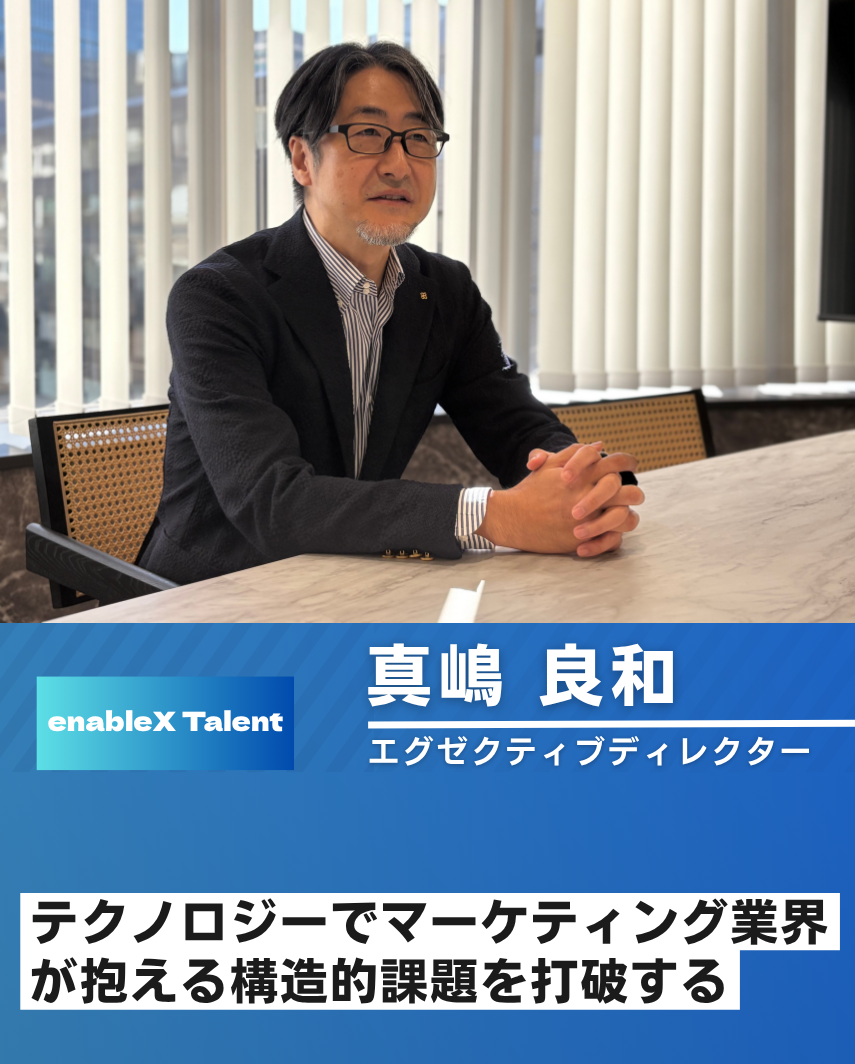
Hakuhodo, CMO at LITALICO, Senior Managing Executive Officer at transcosmos, winner of the Cannes Lions and other accolades — Majima, who has consistently run at the front of the marketing industry, speaks about the future he is now pursuing at enableX in the AI era.


Opening the Industry's Future with an AI-Native Marketing Process — Interview with Majima
2025.11.16
Hakuhodo, CMO at LITALICO, Senior Managing Executive Officer at transcosmos, and in the creative domain a recipient of the world's three major advertising awards — Cannes Lions, the Clio Awards, and The One Show — Majima has consistently run at the front of the marketing industry. He has felt the industry's transformation firsthand, from the dawn of digital marketing through today's AI era. Why join enableX now? We asked him about his ambitious vision of building an AI-native marketing process, and the essential challenges the industry faces.
From NTT to Hakuhodo — from the broadcasting business to the world of advertising
— First, please tell us about your career.
I joined Nippon Telegraph and Telephone Corporation — what we know as NTT — in 1998. They had only just officially returned to the NTT name recently. Back then they were still hiring as a single company, and in the following year, 1999, the company was split into East, West, and Communications, and I moved to the East side.
At NTT East, I was assigned to the team handling business for broadcasting, and joined the development project for the customer management system of SKY PerfecTV!. The scheme at the time had NTT hold the system and have SKY PerfecTV! use it — a rare opportunity to participate in a large-scale development project.
In parallel with that project, I also worked on a feasibility study for a video-on-demand service then considered the killer content of the broadband era. H.264 (a leading compression scheme for video) had just emerged, and we could finally compress video lightly — so I sensed real possibility. Even so, distribution costs were high, and I felt it was difficult to make the business stand on its own. So I concluded, "This business still belongs to the advertising model," and moved to Hakuhodo with the goal of learning the advertising business.
— What experience did you gain at Hakuhodo?
Although I always wanted to be involved in new business development from the agency side, I felt I should first experience the core advertising-agency work, so I took on production-sales duties.
Right after I joined, I was suddenly assigned to a brand-movie production for a luxury jewelry watch — I had to step into a completely different world. And just after starting, I was sent on a business trip to Italy. The founder of the brand I was covering had passed away, and we were going there to create a tribute book. I am still grateful for being given a challenge of that magnitude so soon after joining.
Afterwards, with H.I.S., I gained a full range of media and creative experience — from direct flyers and newspaper ads through to TV commercials. And then I was finally assigned to the Sony team.
— Was your work on Sony a turning point in your career?
Yes. The Sony team essentially relied on central media buying, did not handle media itself, and competed mainly through communication planning centered on creative work. Sony as a brand was still very strong in Japan then, which created an environment where excellent creators were assigned to the account, and being able to work with Hakuhodo's top creators was a rare experience.
At that point, an inexplicable internal branding began — "You're from NTT, so you must be able to do digital, right?" (laughs). That was the moment my involvement with digital grew. I teamed up with an outstanding creator to develop the "Cam with me" content for the Handycam promotion — a piece that let people experience the simulated feeling of raising a child — and we received a Cannes award. That remains a good memory.
After that, while working with Sony Marketing for about five years, I helped reclaim the role of lead agency for Sony Computer Entertainment — that is, PlayStation — and went on to handle the launch communications for PlayStation 4.
In parallel with that launch, executives directed me to participate in the competitive pitch with Mercari, and I led their first-ever TV promotion. My Hakuhodo years gave me the chance to participate in many wonderful projects.
Ultimately I moved to a staff function and joined the launch of a department focused on driving digital with clients directly. From there I went on to become head of that department.
— And then you decided to move to an operating company.
I had experienced many things — broad but not always deep — as an agency person, and as my involvement with startups grew, I received an offer to join LITALICO as CMO. At LITALICO, I led brand renewals for three businesses.
With that brand renewal complete, I thought about the next challenge, and moved on to driving DX at transcosmos.
The challenge at transcosmos — on the front lines of marketing DX
— What role did you take on at transcosmos?
For the first three or four years, as Deputy Head of the Digital Transformation Headquarters, I built and led a team that did planning without being constrained to a specific area — contact center, advertising, site production, and so on.
After that, with the advertising division struggling to grow, I took on the advertising division as its head, holding business accountability. Behind the scenes I also established a subsidiary called Brand Operation and stood up an organization that supported clients' marketing on a neutral basis, without being tied to specific media.
In the end, I oversaw three divisions and the subsidiary — Digital Agency Headquarters, ECX (EC-related Shopify enablement and fulfillment) as the responsible executive, and the entire transcosmos Marketing Headquarters as its General Manager.
Three phases of evolution in digital marketing — and on to the AI era
— Through your career, how have you experienced the marketing industry's transformation?
I view the evolution of the marketing industry in three phases.
Phase 1 was the rapid-growth period of platforms. Digital was introduced as an "add-on" to analog, and specialist agencies emerged.
Phase 2 was the era of building integrated communication centered on digital, where the boundary between mass advertising and digital disappeared.
And today is Phase 3 — the era of structural change driven by AI.
— Please tell us more about the characteristics of Phase 3.
We are at the point where the work to which large numbers of people once devoted themselves — data analysis and reporting — is being replaced by AI. As a result, humans can focus on their original strengths: creativity and strategy.
Local optimization undermining global optimization — the industry's structural challenge
— How do you view Japanese companies' use of AI and technology?
More companies are "using" AI, but I sense that there are still few who have actually "optimized" with it.
Even when operations become more efficient at the task level, total work hours and personnel costs have not gone down. In short, they have not built an AI-native marketing process.
One cause is the diversification of marketing. Optimization advances by platform, and the more sincerely each owner pursues their work, the more overall alignment breaks down. Optimizing CPA may lower LTV — local optimization is impeding global optimization.
In other words, there is no one taking a bird's-eye view and orchestrating it all.
— What do you see as the obstacle to reaching AI-native processes?
I think the diversification of marketing weighs enormously.
In advertising, for example, the number of platforms has grown significantly, and you have to operate each one in line with its own algorithm. Everyone is pouring focus into that local optimization. Or with owned media operations on social, because each owner takes their role and mission seriously, local optimization advances — and I believe that is precisely what is undermining global optimization.
The same applies to trade-offs like: "What happens to LTV if you optimize CPA?" Which lens, which point you prioritize, changes how the decision should be framed.
— So there is no one taking a bird's-eye view of the whole.
Exactly. It is quite difficult to secure the kind of person who can properly take that bird's-eye view, plug in the technology, and orchestrate it.
Toward building an AI-native marketing process
— What would you like to realize at enableX?
By building an AI-native marketing process, I want to co-create with our clients in a form where humans can specialize in the more human layers — creativity and strategy. On top of that foundation, by bringing in highly creative creators, I would like to raise the quality of marketing communications further.
— Concretely, what kind of process do you have in mind?
First, properly preparing the data foundation is the basis. On that foundation, AI is leveraged within the marketing process and applied to planning. The reporting and analysis that follow are then fed back into planning. I want to properly build that cycle.
— That means the roles of people on the front lines will also change.
While I don't actually think people will become unnecessary, I do think reskilling will be required.
Automation products are increasingly coming out — Google's Performance Max, Meta's Advantage+, and others. We let the platform side handle platform-level optimization, while what lies beyond — how to make judgments when looking at the channel as a whole — has to be done by humans.
Furthermore, we must look at the creative for it, and the relationships among elements when you take a bird's-eye view of the business. Each person needs to shift toward standing one step back and moving one step upstream from where they have been.
What only enableX can do — the strengths of a business-development firm
— Why did you decide to realize this at enableX?
enableX is a firm that drives business development and is positioned to engage directly with the executive layer.
It can take the bird's-eye view of issues that cannot be seen from within the front lines, and have the conversation: "to grow the business, renew the process." That is why I considered enableX.
— What about the angle of organization design?
Renewing a marketing process is, frankly, something the people fully consumed by their day-to-day work cannot do. The major point is that, by stepping in from one step back, we can support that transition.
In my previous role too, when changing the marketing planning process, we did not rely on the people doing the day-to-day work. We built a separate dedicated team and pursued the change hands-on. I also believe that approach can quickly achieve optimization.
Looking for talent with a "neutral" mindset and a willingness to cross boundaries
— What kind of people do you want to work with at enableX?
The keywords are "neutral" and "cross-boundary."
I want to work with people who, for the client's challenge, do not limit themselves by means — flexibly choosing the optimal approach and seeing it through to the end. No one has yet realized AI-native marketing.
What matters more than experience is the "willingness to keep learning" and the "posture of co-creating."
— Some people may be worried about whether they can do it themselves.
What matters for taking on the challenge is not only your prior experience, but how you will keep learning, and how we will build it together from here.
I think the most important thing is the mindset to take an interest in new things, absorb them, and improve. If a person genuinely holds that, then even though catch-up speeds will differ from person to person, they can become a colleague we can build with.
— Finally, please share a message for those considering joining enableX.
Transforming a marketing process involves diverse processes intertwined together. At this stage, I don't think anyone can grasp it all.
That is exactly why we have an environment in which each person can expand their role by leveraging their individual strengths. Centered on your own role in the whole, I hope you will see this as an environment where you can broaden your scope after joining.
Let's build the future of AI-native marketing together.